File 02
02 / 07
Tar, wax, dark fruit
No other rum is mistaken for a Caroni. Behind the cliché of the “hydrocarbon taste” lies a profile built at fermentation, structured by the opposition between heavy and light rums.
HEAVY — HTR
The heavy rums
Rich in esters and higher alcohols, they push the Caroni signature to its peak: tar, hot bitumen, leather, black olive, overripe fruit. A small fraction of the distillate, drawn early off the first column, is enough to create them — and these are what collectors chase.
LIGHT — LTR
The light rums
Distilled far higher (up to 94.5% before reduction), clean, almost neutral, they were made mainly for blending. Low in aroma, they often travelled anonymously inside other islands' blends. Few were ever bottled under their real name.
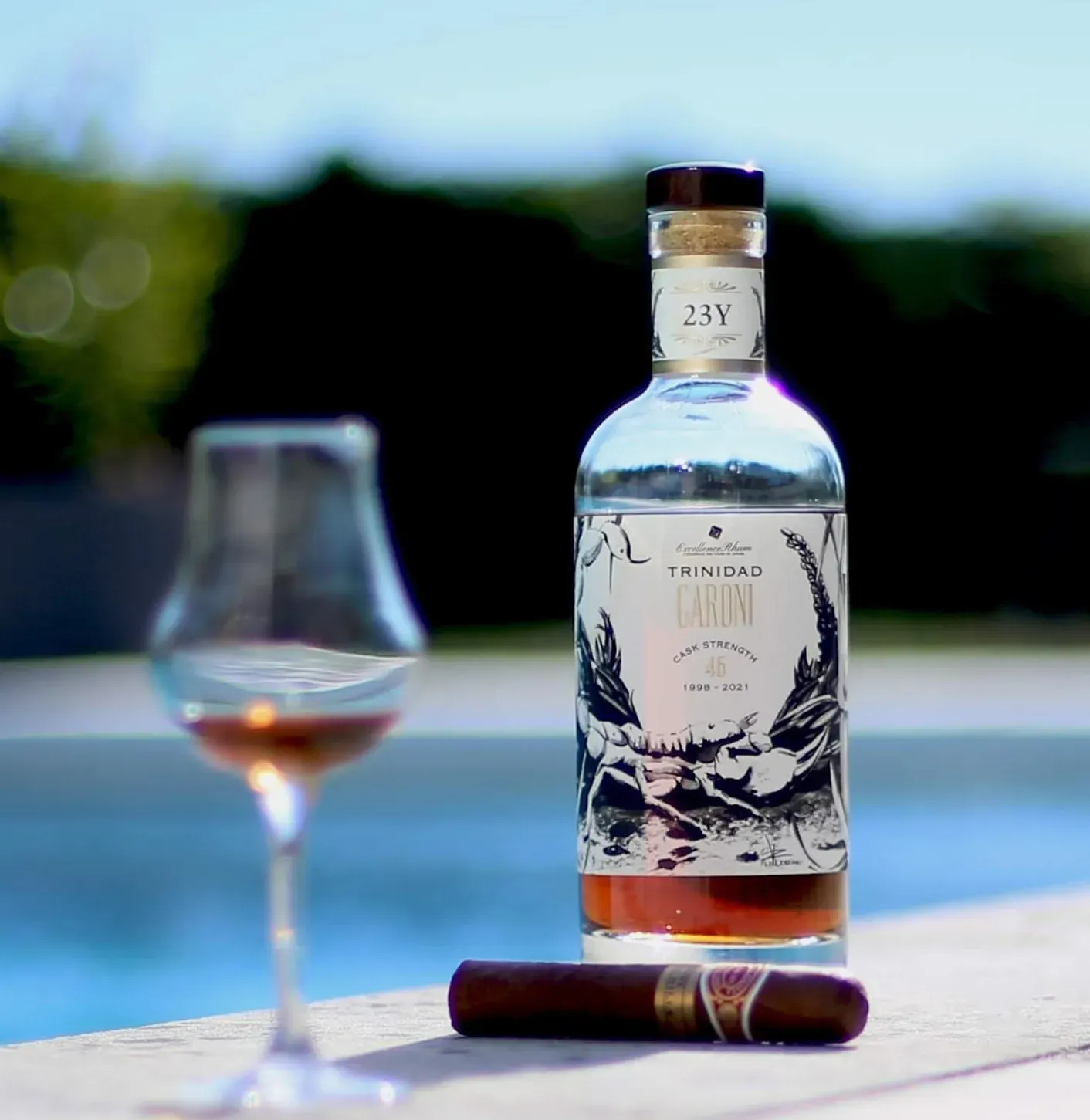
Where does the “Caroni taste” come from?
The descriptor that always returns is tar: hot asphalt, a road melting in the sun, mastic, rubber, glue, varnish. People speak of “hydrocarbon”, and the image is more than easy metaphor — Trinidad is, after all, home to a genuine natural asphalt lake, the Pitch Lake. But to reduce Caroni to that single note would be a mistake.
Beneath the tar unfolds a dense palette: black olive and brine, worn leather, tobacco, bitter cocoa, very ripe fruit (mango, prune, blackened banana), marzipan, raisin, sometimes a medicinal or camphor edge. On the palate the texture is oily, almost waxy, with a noble bitterness that lingers across the mouth.
In some circles it is fashionable to marvel at Caroni's burnt-tyre taste. For others, that is precisely where the rum's genius lies.
That polarisation says it all: Caroni divides opinion as few rums have before it. Where some distillers see flaws — an excess of fusel oils, “dirty” notes — the aficionados hear a signature. A saying in the trade captures the logic of heavy English-style rum: the more off-putting the associations on paper, the more fascinating the rum in the glass.
It all happens at fermentation
Caroni's secret does not hide in the cask, but far upstream, in the fermentation vat. That is where the congeners are born — esters, aldehydes, volatile acids and higher alcohols — that give the rum its character. Molasses holds more than eighty of them in latent form; the yeast's job is to reveal them.
Where most distilleries finish a fermentation in 24 hours, Caroni took its time: up to five days for heavy-type rums. The longer the fermentation, the richer the wash grows in aromatic compounds. The house applied, in its own way, the motto dear to Jamaican distillers: more time means more flavour.
One more detail sets the house apart: the water. Dr Rawle Biran, a former manager, recalls that Caroni drew from artesian wells a very lightly mineralised spring water, precious for the health of the yeast. The neighbouring distillery worked with tap water. A "little extra" that, added to the molasses, the strain and the duration, shapes a unique distillate.
Heavy versus light: a matter of the cut
The core distinction is one of distillation method and cut. On the four-column plant installed in 1980, a small part of the distillate is drawn very early, off the first column, where the alcohol still stands at only 50 to 60%. Rich in congeners, this is what yields the heavy (HTR) rums. The rest travels on through the following columns, where water is added to strip out unwanted compounds and where proof climbs very high: this is the light (LTR) rum, clean, almost neutral.
Tropical ageing, fast and greedy — the famous “angels' share” heightened by the heat — then concentrates everything. This is why the most sought-after Caroni are at once heavy, old and full tropical: three conditions that compound one another.
The mystery of the 3,818 Jamaican casks
During the stock inventory of 2000, the assessors found an anomaly: 3,818 casks of Jamaican rum lay dormant in Caroni's warehouses. Where did they come from? The most credible lead points to National Rums of Jamaica (probably Monymusk): alarmed by the closure, Jamaican producers are said to have imagined shipping rum over to "improve" Caroni's blends.
The link is no accident. Just six months after buying Caroni in 1937, Tate & Lyle founded WISCO in Jamaica and took over the Monymusk distillery. Exchanges of know-how, staff moving back and forth between the two islands: it is likely that part of Caroni's aromatic secret owes something to the Jamaican tradition of heavy rum.
How to taste a Caroni
A few principles for approaching these rums without rushing them:
- Serve at room temperature, in a tulip glass that concentrates the aromas.
- Let the glass open for several minutes: the opening tar gives way to fruit and leather.
- Take very small sips — proofs are often high, especially at cask strength.
- A drop of water can reveal the fruity thread (marzipan, raisin) of the most powerful versions.
- Don't compare it to a sweetened rum: Caroni is tasted dry, in the line of great sipping rums.
The right instinct: don't look for “good” or “bad”, but identify the balance between the tarry part, the fruity part and the woody part. That is where age and bottler show.
With this profile in mind, reading the bottlings and their vintages becomes far more telling.
80+ compounds
Aromatic congeners present in molasses
5 days
Fermentation possible for a heavy rum
94.5 %
Proof of the light after distillation
3818 casks
Jamaican rum found at Caroni